Welp, This Should Be Interesting…Let’s Talk About BPA
Hiii.
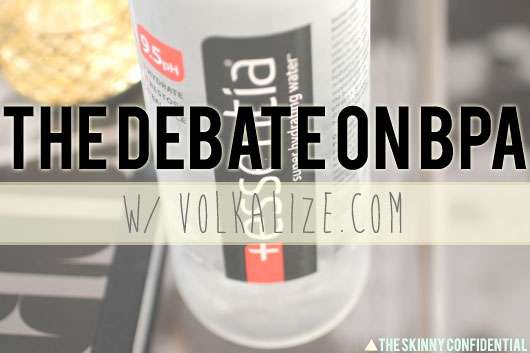
Today I’m teaming up with the website, Volkalize which was founded by my girlfriend, Jordan. Volkalize is a political, social networking site that integrates politics with pop culture. It’s a super rad site that welcomes opinions from anyone, anywhere.
Today’s topic?
BPA.
But before I go off on a rant, just remember: I’m not a full-on BPA expert/scientist/doctor.
I’ve simply read up on it— & naturally ( shocker ), I have a strong opinion.
Conclusion:
BPA free > BPA.
I just don’t understand why anyone would willingly drink water from a water bottle containing BPA when there’s a BPA free option.
But wait, wait. Let’s back up.
For anyone that’s wondering WTF BPA is:
The FDA ( The Food & Drug Administration ) kinda doesn’t want to know about BPA ( short for Bisphenol A )…This source states that “even though the FDA’s troubled by the lack of better information about the safety of BPA, it recently denied a petition from the National Resources Defense Council to ban it ( see FDA Law Blog for details ). Although FDA is not persuaded by the data and information in your petition to initiate rule-making to revoke the food additive approvals for BPA, FDA will continue in its broader and more comprehensive review of emerging data and information on BPA.”
So it’s kind of like this: ‘hey! I’m the FDA and I’m so freaking worried about BPA. I won’t let my kids have it & I’m not touching it with an eighty foot pole BUT I’m not going out of my way to warn other’s about its effects without more evidence. Sorry, I’m not sorry!’
Ignorance is bliss, ehh?
Not so much.
BPA is used to make hard plastics for water bottles ( & FYI to all the mamas out there: baby bottles too ). Oh, & it’s in many cans, register receipts, dental sealants, toilet paper ( SICK! ) &/or paper money. It’s also used for food supply.
A lot.
Like, a lot, a lot.

BPA was first approved by the oh-so-ever-lovely FDA in 1960’s.
BUUUUTTTT in 2010 the ‘see no evil, hear no evil, speak no evil’ FDA issued an update with a report stating that BPA is safe at current levels…and then the FDA went on to suggest reducing exposure is recommended.
Hmmmm.
Let’s all go bury our head’s in the sand with the FDA. Might be fun.
Here’s another fun fact…this is how the FDA answers questions to parents:
Question: Should I throw away baby bottles that contain BPA?
FDA: Parents should examine bottles and discard them if worn or scratched because scratches can both harbor germs and, in BPA-containing bottles, lead to greater release of BPA. For those who want to use baby bottles and feeding cups not made with BPA, consumers should know that such products are now widely available in the U.S. market.
Let’s take the BPA debate a bit further: the US Centers for Disease Control has reported that ninety percent ( yes, you heard correctly- ninety percent ) of Americans have “detectable levels of BPA in their urine.”
Yuck x 10.
The facts: “Approximately six pounds of BPA are produced for every American per year. Bisphenol A is a hormone-disrupting chemical, which means that it can mimic or block hormones and disrupt the body’s normal functions. Numerous studies suggest it can have health effects at extremely low exposure levels. BPA is especially of concern for vulnerable populations: pregnant women, babies and children.”
FML.
Ok soooo…BPA bans are in place in twelve states & several countries.
States with the ban: California ( << thank God! ), Connecticut, Delaware, Illinois, Maine, Maryland, Massachusetts, Minnesota, New York, Vermont, Washington, & Wisconsin.
& then there’s Europe. The European Union banned the manufacture of sale of baby bottles with BPA.
Always one step ahead of us, USA!
Some of the health concerns the FDA doesn’t want to address : delayed brain development, hyperactivity, reproductive development, decreased testosterone/sperm production, reproduction & conception, miscarriage & Down’s syndrome, heart disease, diabetes, obesity, & cancer, behavioral impacts in kids.
Personally, I drink Essential Water. I like the taste. I like how the water contains 9.5 pH, and it’s BPA-free. I also like People Water. And my absolute BPA-free glass bottle can be found here ( more options below ).
If you get anything out of this post, just remember this: please, please do NOT leave a water bottle & any kind of plastic in your car when it’s hot outside; the heat makes the nasty-ass chemicals leak into the water, beverage, &/or food.
So.
I’ll end with this quote:
“The big question is how BPA got so widespread in the products we use everyday as food containers and especially in baby bottles … We can and must do better when it comes to foreseeing trouble related to the chemicals we put into our environment. Right now we have too much of a buy now and pay later approach to chemical safety. Tens of thousands of chemicals are in use and hardly any of them have been studied with any rigor for their safety. Wouldn’t it make more sense to test for harms first rather than find out later?”
–Dr. Aaron Bernstein, Harvard Medical School Center for Health & the Global Environment
What’s your opinion on BPA? Please, please share!
x L
** {{ Check out The Skinny Confidential’s BPA debate on Volkaize here. }}







Post Comment